
The image most people have of a dog tearing its ACL is a sudden one: a bad landing off the sofa, a sharp turn chasing a ball, a yelp and then a limp. Some tears do happen that way. Far more often, though, the ligament has been weakening for months before that one ordinary jump finally finishes the job. What looks like a single accident is usually the last step in a slower process, and that distinction changes what actually needs to happen next.
What’s Actually Tearing, and Why It Happens So Gradually
What’s commonly called an ACL tear in dogs is technically an injury to the cranial cruciate ligament, the canine equivalent of the human ACL, and in most dogs it fails through gradual degeneration rather than a single traumatic event. The ligament fibres weaken progressively, often linked to a dog’s own leg conformation, body weight, and age, long before any visible limp shows up. By the time a jump or an awkward twist causes the final rupture, the ligament has usually already lost a meaningful amount of its original strength. That’s part of why the injury turns up so often in dogs that were never especially active or athletic to begin with.
The Other Knee Is Often Already on Borrowed Time
Because the same gradual weakening process tends to affect both back legs rather than just the one that happens to go first, a dog that’s torn one cruciate ligament has a meaningfully higher chance of tearing the other within the following year or two. Owners are rarely warned about this clearly enough, which is why a second limp sometimes gets mistaken for a brand-new, unrelated injury instead of what it usually is. The added strain of favouring one leg while the other heals can also accelerate wear on the uninjured side, which is one more reason recovery planning tends to look at both hind legs rather than just the obviously injured one.
Signs That Tend to Show Up Before a Full Limp Does
- A dog sitting with one hind leg held out to the side rather than tucked normally underneath.
- Reluctance to jump into a car or onto furniture that was never a problem before.
- Visible thinning of the thigh muscle on one side after a few weeks.
- A limp that comes and goes rather than staying constant, often worse after rest.
Why Surgery Alone Rarely Finishes the Recovery
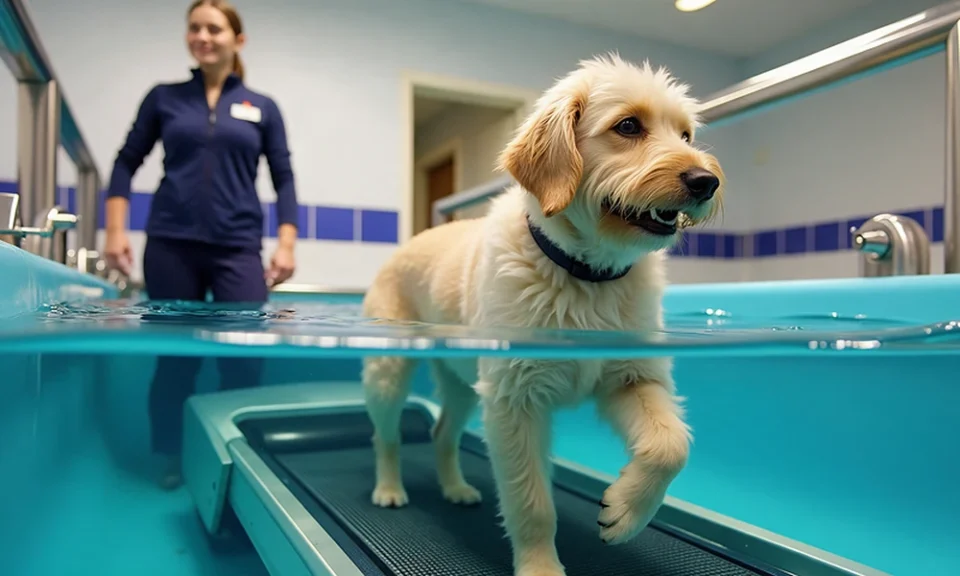
Whichever surgical technique is used to stabilise the knee, the repair itself mostly addresses the mechanical problem. The muscle that wasted away while the dog was limping, and the confidence a dog has in putting weight on that leg again, don’t come back just because the joint is now stable. This is usually where a veterinary rehabilitation and hydrotherapy centre becomes part of the plan rather than an optional extra, since structured, supervised exercise is what actually rebuilds strength and normal movement patterns once the surgical side of things is done. Skipping this step is a common reason a dog can recover from the surgery itself but never quite return to moving the way it used to beforehand.
What a Hydrotherapy Session Is Actually Doing Underwater
An underwater treadmill works by using water’s buoyancy to take weight off a healing joint while still asking the surrounding muscles to work. That combination, less load but genuine effort, is difficult to replicate on dry land, especially early in recovery when full weight-bearing is still uncomfortable. Water depth and treadmill speed are typically adjusted as a dog progresses, under the supervision of someone trained to read how that specific dog is actually responding rather than following a fixed template. It’s a slower, more deliberate process than it might look from the outside, and that pacing is largely the point.
A Timeline Worth Setting Expectations Around
- Early improvement is often noticeable within the first few sessions, though how much and how fast varies by dog and by severity.
- A full return to normal muscle mass and movement typically takes months, not weeks, even after a technically successful surgery.
- Progress isn’t always a straight line; a setback after a good week doesn’t necessarily mean the plan isn’t working.
- Home exercise between sessions tends to matter just as much as the sessions themselves.
Recovery from a cruciate injury is rarely something that happens entirely inside a clinic. The exercises, activity limits, and small daily routines an owner keeps up at home between sessions often decide how much of that structured work actually sticks, which makes the owner as much a part of the rehab plan as any piece of equipment.
Working out what a specific dog’s recovery plan should actually involve starts with a proper assessment, not a general description of how the injury usually behaves. Contact Bluewater Vet Acupuncture & Rehabilitation to arrange that.
